Context
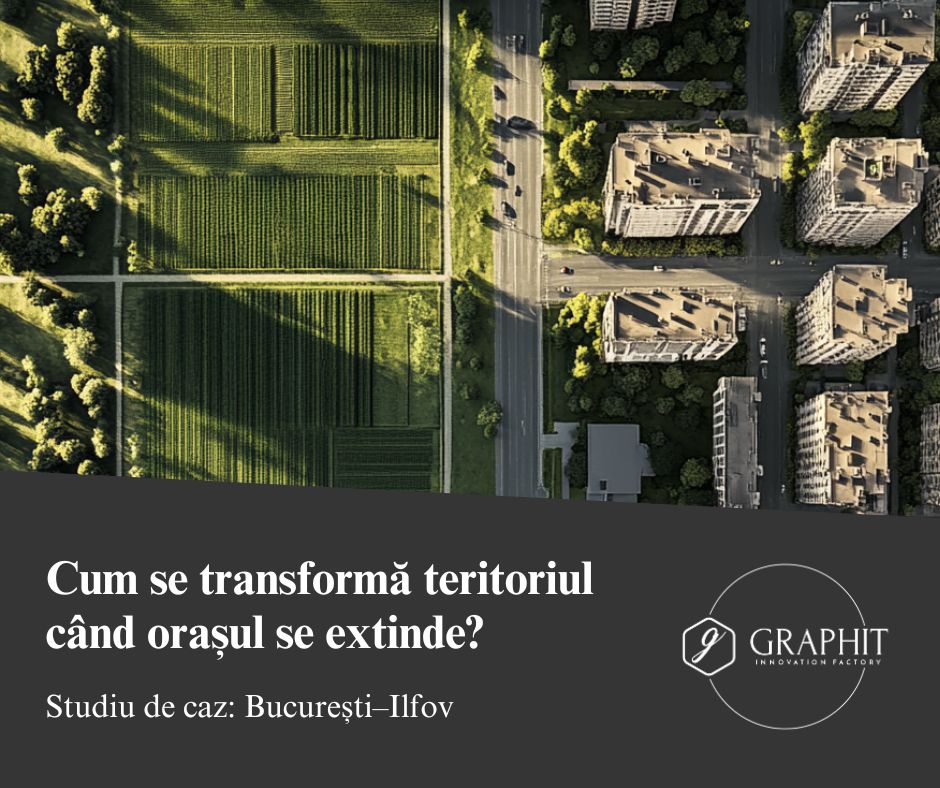
The Bucharest–Ilfov metropolitan area is undergoing rapid urbanization, placing significant pressure on agricultural land and territorial balance. The expansion of built-up areas leads to the loss of agricultural land, landscape fragmentation, and structural changes in land use.
In this context, the research published under the title “The Impact of Urban Expansion on Land Use in Emerging Territorial Systems: Case Study Bucharest-Ilfov, Romania” analyzed land-use changes between 1990 and 2018, focusing on the impact of urban expansion on agricultural areas.
Methodology
The study used the Corine Land Cover database, provided by the Copernicus Land Monitoring Service (CLMS), covering the period 1990–2018. Data processing and analysis were carried out using the open-source QGIS platform, beginning with the reprojection of the data into the national coordinate reference system Pulkovo 1942(58)/Stereo 70 (EPSG:3844).
The applied methodology made it possible to identify both quantitative and structural land-use transformations, providing a clear understanding of the timing and mechanisms of territorial conversion.
Key Findings
The findings confirm that socio-economic pressures associated with the transition to a new economic structure have generated significant changes in land use.
Urban expansion was the dominant factor, leading to a dramatic reduction in agricultural land, the most affected category during the analyzed period.
At the same time, residential, industrial, and commercial areas expanded, reflecting both demographic pressure and real estate market dynamics.
Implications
The observed transformations highlight the vulnerability of agricultural land in peri-urban areas to uncontrolled urbanization.
These findings emphasize the need for coherent public policies regarding spatial planning and agricultural resource protection, ensuring a balance between economic development and food security.
Furthermore, the methodology demonstrates the value of open-source GIS tools and satellite-based databases in monitoring land-use pressures.
Conclusion
Urban expansion in the Bucharest–Ilfov metropolitan area has caused profound territorial transformations, directly affecting agricultural land.
The analysis based on Corine Land Cover (CLC) data and GIS tools confirms the systemic nature of these changes and provides a scientific foundation for developing sustainable urban development strategies and effective agricultural land management.